
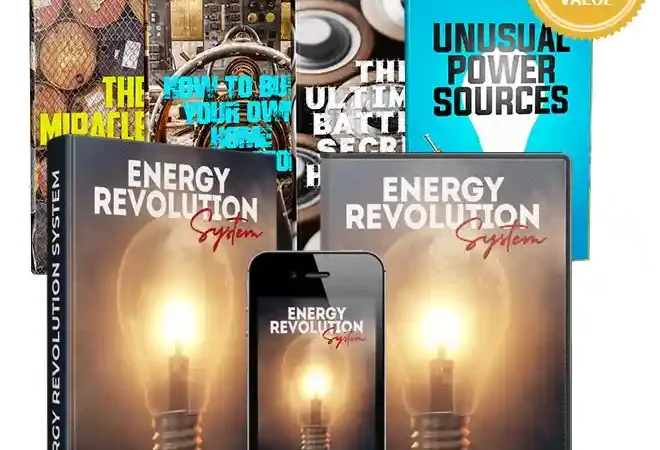
If you have been searching for Energy Revolution System reviews, you have probably encountered impressive promises about reducing electricity bills, generating power at home and becoming less dependent on traditional electricity providers.
The Energy Revolution System is marketed as a Tesla-inspired DIY energy project. Its promotional material suggests that ordinary homeowners can build a compact electricity-generating device using relatively inexpensive materials.
But does the Energy Revolution System really work? Can it power household appliances? Are the advertised savings realistic, or should potential buyers be cautious?
In this independent Energy Revolution System review, we examine what the product offers, the scientific principles behind its design, customer feedback, potential costs, safety considerations and more practical alternatives.
Quick verdict: The Energy Revolution System is presented as a digital DIY electronics guide, not a ready-to-use generator. Its educational potential should be separated from its much stronger electricity-saving claims. We found no independently verified evidence establishing the advertised household savings or self-sustaining power generation.
What Is the Energy Revolution System?
The Energy Revolution System is a digital instructional product that reportedly provides information about building a small electricity-related DIY device.
Unlike a conventional generator, it does not arrive as a complete physical machine. Instead, customers are offered digital materials intended to explain the construction process.
The advertised project references electromagnetic principles and Nikola Tesla’s historical research into bifilar coils.
What Does the Package Include?
Descriptions of the offer refer to materials such as:
- Digital construction instructions.
- Technical diagrams and blueprints.
- Component and materials lists.
- Video tutorials or demonstrations.
- Additional instructional resources.
However, buyers should verify the exact contents at checkout because digital product packages and promotional bonuses can change.
Is It a Physical Generator?
No. It is marketed as a digital guide rather than a finished generator.
This distinction matters because purchasing instructions does not guarantee that the completed project will produce useful electricity.
The buyer may also need to purchase additional components, tools and electrical equipment.
How Does the Energy Revolution System Work?
The promotional material references magnetic fields, electromagnetic induction and Tesla-inspired coil arrangements.
These are real scientific concepts. However, understanding the underlying science is essential before accepting claims about electricity generation.
1. Tesla’s Bifilar Coil
Nikola Tesla patented a bifilar coil design in the nineteenth century. A bifilar winding uses two parallel strands of wire arranged in a particular configuration.
Such coil arrangements have legitimate electrical applications involving inductance and capacitance.
Nevertheless, a historical invention does not automatically validate every modern product marketed using Tesla’s name.
2. Electromagnetic Induction
Electromagnetic induction is an established scientific principle.
When the magnetic flux through a coil changes, an electrical voltage can be induced. This principle is used in conventional generators, transformers and numerous electrical devices.
A magnetic field alone, however, does not provide an unlimited supply of electricity.
A generator needs an external energy source, such as mechanical rotation, wind, flowing water or another form of energy.
3. The Energy Conservation Problem
One of the most important questions concerns the suggestion that a magnetic device can continuously generate electricity without requiring additional energy.
According to the law of conservation of energy, energy cannot simply appear from nothing.
Real electrical systems also experience losses through resistance, heat, friction and other inefficiencies.
Therefore, a device cannot continuously deliver more usable energy than it receives.
A coil-and-magnet arrangement can demonstrate electromagnetic induction. However, that does not establish that the Energy Revolution System can operate as a self-sustaining electricity source.
Energy Revolution System Reviews: What Does the Evidence Show?
The original LinkedIn review describes a personal building experiment involving copper wire, magnets, PVC components and electrical materials.
It reports approximately $49 for the guide and $127 for construction materials.
The author also reports producing enough electricity for LED lights and small electronic devices.
However, these results should be treated as individual, unverified claims.
The article does not provide independent laboratory measurements, documented energy-input calculations or reproducible testing records.
What About the Reported Electricity Savings?
The LinkedIn author reports approximately $31 in monthly electricity savings.
Although that figure sounds encouraging, it is not accompanied by independently verifiable electricity-meter readings.
A reliable energy-saving experiment should include:
- Electricity consumption before installation.
- Electricity consumption after installation.
- Total energy supplied to the device.
- Total energy produced by the device.
- Testing duration and operating conditions.
- Independent verification of the measurements.
Without these details, it is impossible to determine whether the reported savings came from the device, changes in electricity usage or other factors.
What Are Other Customers Saying?
Publicly available information includes positive promotional-style reviews as well as critical customer feedback.
For example, the Trustpilot listing associated with the product domain displayed a 2.9/5 TrustScore based on two reviews when retrieved for this research.
That is a very small sample and cannot represent the entire customer base.
Some published reviews question the scientific credibility of the promised electricity savings. Others describe the product more positively as an educational DIY project.
The important takeaway is that customer testimonials should not replace independent technical evidence.
Does the Energy Revolution System Really Work?
The answer depends on what you expect it to accomplish.
| Expected outcome | Evidence-based assessment |
|---|---|
| Learn about electrical coils | Plausible educational use |
| Understand electromagnetic induction | Possible through practical experiments |
| Generate a measurable voltage | Possible with a properly designed generator and energy input |
| Run LED lights | Possible depending on the actual power source and output |
| Charge mobile phones reliably | Not independently established |
| Power refrigerators or air conditioners | Not demonstrated |
| Eliminate electricity bills | Unsupported |
| Generate unlimited free electricity | Contradicts established physics |
Can It Power Household Appliances?
Household appliances require specific voltage, current and power levels.
A small electrical experiment that lights an LED is not equivalent to a system capable of running a refrigerator, washing machine or air conditioner.
For example, a refrigerator may require substantially more power than a small demonstration circuit.
Buyers should request measured continuous output in watts, usable energy in watt-hours and information about the required external energy input.
Without those measurements, household performance cannot be established.
Can It Provide Electricity During a Power Outage?
This is another important issue.
A device cannot provide continuous backup power simply because it contains magnets and copper coils.
It needs a source of energy.
For dependable emergency electricity, consider a properly rated battery power station, solar-plus-battery system or conventional generator.
Never connect an experimental DIY generator directly to household wiring.
Energy Revolution System Price and Additional Costs
The LinkedIn review reports a guide price of approximately $49 and material expenses of approximately $100–150.
These are figures reported by that particular reviewer, not independently confirmed current checkout prices.
Your actual investment may differ.
| Expense | Reported or potential cost |
|---|---|
| Digital guide | $49 reported |
| Construction materials | $100–150 reported |
| Additional tools | Depends on existing equipment |
| Replacement components | Depends on design |
| Testing equipment | Depends on requirements |
| Total initial estimate | $149–199 before additional costs |
Before purchasing, check the final checkout amount, any optional upgrades, seller identity and refund conditions.
A low initial purchase price does not necessarily mean the completed project will be inexpensive.
Energy Revolution System Pros and Cons
Potential Advantages
- Digital delivery rather than physical shipping.
- May provide an introduction to electrical experiments.
- Could interest DIY enthusiasts and electronics hobbyists.
- References genuine electromagnetic principles.
- May encourage practical learning about electricity.
- The reported guide price is relatively modest.
Potential Disadvantages
- Advertised electricity savings are not independently established.
- No verified evidence of self-sustaining power generation.
- Additional construction materials may be necessary.
- Building requires technical knowledge and careful assembly.
- Household appliance performance is not demonstrated.
- Actual customer satisfaction remains uncertain.
- The advertised refund policy needs verification.
Is Energy Revolution System a Scam or Legit?
This is probably the most important question for potential buyers.
Based on the information retrieved, we cannot establish that every purchase is fraudulent or that customers never receive the advertised digital materials.
However, we also cannot verify the product’s strongest technical and financial promises.
There is a significant difference between receiving a digital DIY guide and receiving a proven electricity-generation system.
Red Flags Buyers Should Consider
Look carefully for the following warning signs:
- Promises of eliminating electricity bills.
- Claims of generating unlimited free electricity.
- Testimonials without independently verifiable results.
- Missing technical specifications.
- Unclear business ownership or customer support.
- Countdown timers and pressure-based purchasing tactics.
- Unclear refund procedures or additional checkout charges.
The Federal Trade Commission provides guidance on truthful advertising and endorsements. It also has a consumer reviews rule addressing fake and misleading testimonials.
These principles are useful when evaluating any online product that makes extraordinary performance claims.
How to Check Whether the Offer Is Trustworthy
Before making a payment:
- Identify the legal seller and its contact information.
- Read the complete refund policy.
- Confirm the final checkout price.
- Save your payment confirmation.
- Search for independent customer experiences.
- Request measurable technical evidence for performance claims.
Do not rely exclusively on testimonials published on websites that receive commissions from product sales.
Safety Risks of DIY Electricity Generators
Working with electrical components requires proper precautions.
Even low-voltage experiments can cause short circuits, overheating and component damage.
Consider these precautions:
- Use properly rated electrical components.
- Disconnect power before making modifications.
- Avoid exposed conductors and damaged insulation.
- Use suitable protective equipment.
- Keep electrical equipment away from moisture.
- Never experiment with household mains wiring.
- Never connect an experimental generator to your home’s electrical panel.
If you are unfamiliar with electrical circuits, consult a qualified electrician before attempting construction.
Energy Revolution System vs Solar Generators and Portable Power Stations
If your main goal is to reduce electricity expenses or maintain power during outages, compare the guide with established technologies.
| Feature | Energy Revolution System | Solar power system | Portable power station |
|---|---|---|---|
| Product format | Digital DIY guide | Physical equipment | Physical equipment |
| Energy source | Not independently established | Sunlight | Stored battery energy |
| Household backup | Not demonstrated | Possible with suitable battery | Depends on capacity |
| Electricity savings | Unverified | Measurable under suitable conditions | Primarily backup |
| Installation | DIY construction | Equipment installation | Usually ready to use |
| Performance evidence | Insufficient | Established technology | Established technology |
The US Department of Energy explains that photovoltaic systems convert sunlight into electricity using semiconductor materials. Complete systems use additional components to convert and manage the electricity for practical applications.
That is a much more established approach than relying on an unverified self-generating device.
For additional information, consult the Department of Energy’s Solar Photovoltaic Technology Basics guide.
Better Ways to Reduce Your Electricity Bill
If reducing monthly electricity expenses is your priority, consider approaches with measurable results.
1. Conduct an Energy Audit
Identify appliances that consume the most electricity.
Review operating hours, appliance ratings and monthly usage before deciding what to replace.
2. Switch to LED Lighting
LED bulbs generally consume less electricity than traditional incandescent lighting.
Replacing frequently used bulbs can reduce unnecessary consumption.
3. Improve Air Conditioning Efficiency
Air conditioners can account for a significant portion of household electricity use in hot climates.
Maintain filters, avoid unnecessarily low thermostat settings and reduce heat entering the home.
4. Compare Solar Options
Obtain quotations from multiple qualified solar installers.
Compare system capacity, expected annual generation, warranty coverage, installation expenses and applicable local incentives.
5. Consider Battery Backup
If power interruptions are your main concern, choose a battery system based on the appliances you need to operate.
Check its continuous output rating, battery capacity, recharge time and safety certifications.
Frequently Asked Questions
1. What is the Energy Revolution System?
It is a digital DIY guide marketed as a Tesla-inspired electricity-generation project. It is not a complete physical generator delivered to your home.
2. Is the Energy Revolution System a scam?
There is insufficient independently verified evidence to establish that the entire offer is fraudulent. However, its major electricity-saving and self-sustaining generation claims remain unproven.
3. Does the Energy Revolution System really generate electricity?
Coil-and-magnet arrangements can generate electricity when an external energy source creates changing magnetic flux. That scientific principle does not independently verify the performance of this particular product.
4. Can it reduce my electricity bill by 80%?
There is no independently verified evidence establishing that the Energy Revolution System consistently reduces household electricity bills by 80%.
5. Is the Energy Revolution System suitable for beginners?
The digital format may appeal to beginners, but actual electrical construction requires knowledge, appropriate equipment and safety precautions.
6. How much does the Energy Revolution System cost?
The original LinkedIn review reports approximately $49 for the guide. This is not a verified current price. Check the seller’s checkout page for the actual amount.
7. Does it come with a money-back guarantee?
The original review mentions a 60-day guarantee. Buyers should independently verify the current terms, eligibility conditions and refund procedure before purchasing.
8. Can it replace solar panels?
There is no independent evidence that the Energy Revolution System can provide the reliable household electricity generation offered by a properly designed solar installation.
9. Is Tesla’s bifilar coil technology real?
Yes. Tesla’s historical bifilar coil research is real. However, the existence of a genuine electrical design does not prove that a commercial product can generate free or unlimited energy.
10. What should I buy for emergency electricity?
Consider a certified portable power station, appropriately sized battery backup system or conventional generator. Select equipment according to your actual electrical requirements.
Final Verdict: Is Energy Revolution System Worth It in 2026?
After examining the original LinkedIn review, competing product reviews, publicly available customer feedback and established electrical principles, the Energy Revolution System deserves a cautious assessment.
It may interest people who enjoy DIY electronics and want to explore electromagnetic concepts.
However, the available evidence does not establish that it can eliminate electricity bills, provide dependable household backup power or generate electricity without an external energy source.
The most important distinction is between an educational electronics project and a proven energy solution.
If you decide to purchase the guide, treat it as an educational experiment rather than an investment guaranteed to reduce your electricity expenses.
Our recommendation: Do not buy the Energy Revolution System solely because of claims of 50–80% electricity savings or complete energy independence. First request independent performance measurements, verify the seller and read the refund conditions.
For people who genuinely want lower electricity bills or dependable backup power, established energy-efficiency measures, solar systems and properly rated battery solutions offer more measurable alternatives.
Editorial disclosure: This article is an independent research-based assessment. It does not claim personal product testing, guaranteed customer outcomes or an endorsement from Nikola Tesla’s estate, the US Department of Energy or any electrical engineering authority.